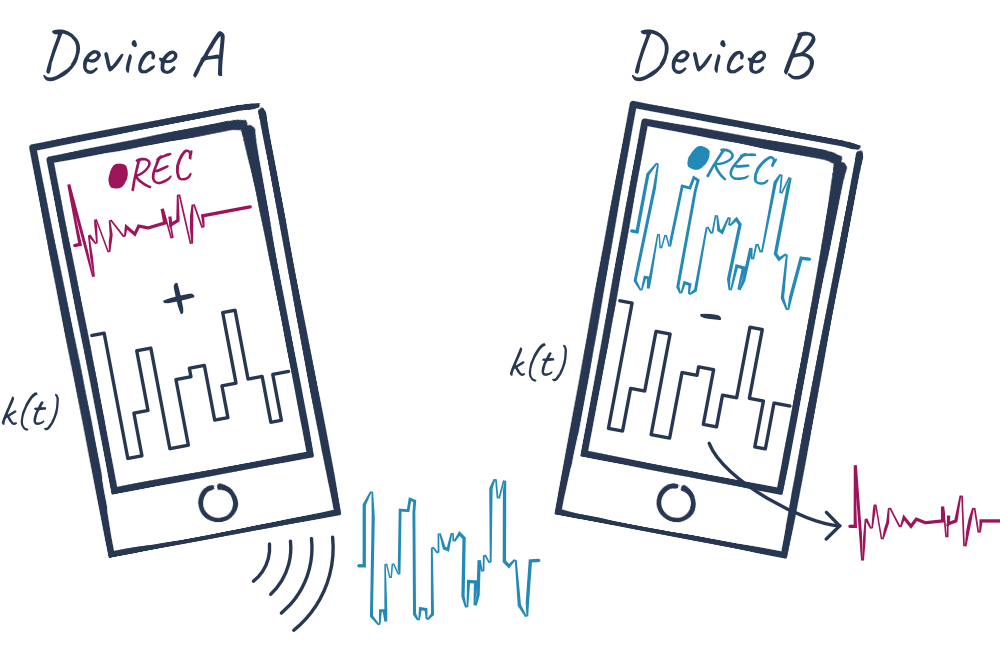
A demonstration of the transmission of enciphered speech, informed by Alan Turing and
Donald Bayley's research on the 'Delilah' project.
First, a time-varying key signal k(t) must be generated. We'll select a seed value, and derive key values from
it.
What is "key"?
In the context of the DELILAH system, "key" refers to the sequence of pseudo-random values generated
synchronously at both the transmitter and receiver.
This sequence, once generated, is destined to be combined with the voice signal data to perform the encryption.
Crucially, the receiver, possessing the identical seed value and employing the same pseudo-random generation
algorithm, will reconstruct the exact same key sequence independently.
In this demonstration, we're using the seed value to create a sequence of values using a pseudo-random number
generator.
In the original prototype, the time-varying voltage signal (k(t)) was produced by dedicated
electronic circuitry (like multivibrators and networks) designed to emulate random noise in a repeatable way.
We'll recreate the original key signal and remove it from the encrypted audio, restoring the original message.
Encrypted
-
=
Original
Not working?
Ensure that the seed values on both devices match
If you're using the record feature to transfer the encrypted audio, hold the two devices so the the speaker
of one faces the microphone of the other
Try again in a quieter environment
Ensure that the original audio is loud and clear
About the Delilah project
The Delilah project was a World War II initiative led by the famous British mathematician and
codebreaker Alan Turing.
Following his critical work on breaking the Enigma code at Bletchley Park, Turing, along
with engineer Donald Bayley, moved to Hanslope Park around 1943 to develop a system for secure voice
communications.
The goal was to create a portable machine that could encrypt and decrypt speech transmitted over telephone or
radio, protecting sensitive military information from being intercepted.
The machine worked by converting the spoken voice signal into a stream of numbers, and adding electronic noise
generated from a secret key, effectively scrambling the speech.
A receiving Delilah machine, set with the identical key, could subtract the same noise pattern, reconstructing
the original speech.
The prototype was successfully demonstrated using a recording of Winston Churchill's speech shortly after the war
ended - it came too late for operational use in WWII.
Nevertheless, it was a pioneering effort in digital speech encryption, showcasing Turing's innovative application
of mathematical and electronic principles to secure communications.
About the Delilah papers
Turing and Bayley kept a logbook of their experimental results. Bayley also kept handwritten notes of lectures
Turing gave to interested Hanslope Park engineers about the mathematics behind the project, along with loose pages
of diagrams, calculations, explanations, and other electronic and mathematical theorems and problems.
In April 2025, these notebooks were acquired thanks to a major donation from trading firm XTX Markets, Friends of
the Nations' Libraries, and further support from the National Heritage Memorial Fund and King's College.
The documents will join the largest collection of Turing-related documents at King's College, Cambridge and -
once digitised - they will become part of the Turing Papers online archive, freely available to scholars.
About this prototype
This prototype aims to allow visitors to experiment with some of the key concepts related to the Delilah project,
including the use of time-varying pseudo-random noise to obfuscate audio.
Development of this prototype was supported by XTX Markets.
For simplicity and to create an engaging prototype, there are some differences between the Delilah system as set
out in the papers, and this prototype. The
Delilah Rebuild Project, led by John Harper and supported by HMGCC, is an ambitious project to rebuild
Turing's Delilah machine in hardware.
In this prototype, audio is processed on-device, and is not sent over the network.
It looks like we weren't able to process the audio on this device.
Instead, here's a demonstration of how the process works on an example piece of audio